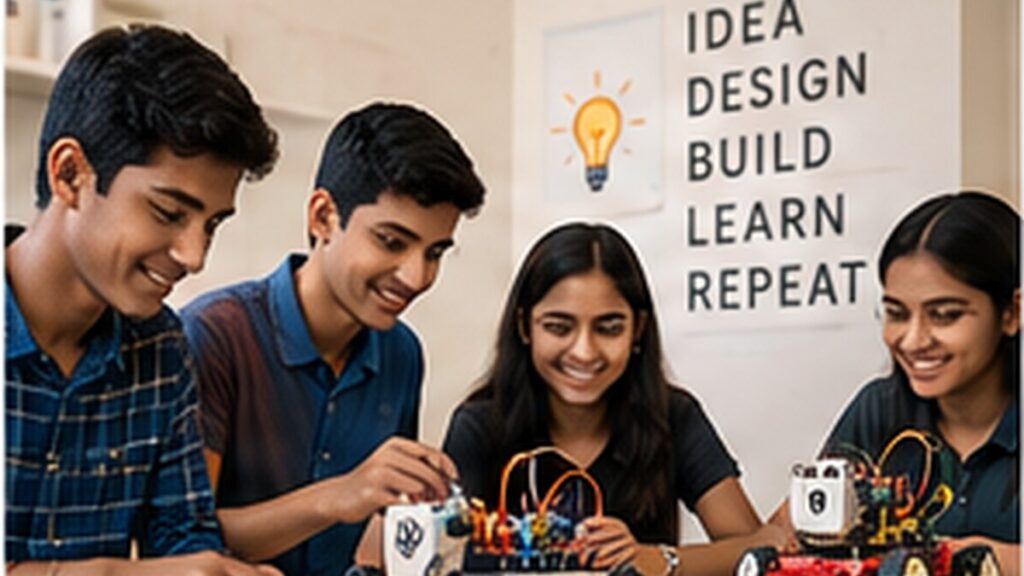
A project forces a student to move from knowing something to doing something. That difference is important. In a project, the learner has to make decisions, deal with mistakes, organise time and explain a result to someone else.
This guide is written for students, parents and teachers who want practical, realistic information rather than a list of buzzwords. Use it as a starting point, adapt it to the student’s age and interests, and focus on completing small projects properly instead of trying to do everything at once.
Projects turn theory into decisions
In a textbook problem, the inputs are usually already defined. In a project, students must decide which sensor to use, how large a dataset should be, how a page should be arranged or how the final model should be demonstrated.
Those decisions build judgement. Even a small choice—such as selecting a motor driver or deciding how to validate a form—creates an opportunity to connect theory with a real constraint.
- Choosing tools
- estimating cost
- setting priorities
- testing assumptions
Projects teach debugging and resilience
Real systems rarely work perfectly on the first attempt. A loose wire, incorrect variable, reversed motor connection or poor dataset can stop a project. Learning to investigate one possible cause at a time is a major practical skill.
Students gradually learn that an error is information. Instead of restarting randomly, they isolate the problem, test a hypothesis and record the result.
- Reproduce the issue
- check the simplest cause first
- test one part at a time
- change one variable
- record the fix
Projects improve communication
An exhibition, internship review or portfolio interview requires more than a working result. The student must explain the problem, architecture, challenges, trade-offs and what they would improve next.
Project documentation also develops written communication through diagrams, README files, reports and presentations.
- Problem statement
- block diagram or architecture
- demo
- test evidence
- future improvements
Projects create evidence of learning
A certificate says that a student attended or completed something. A project can show what the student actually built. That evidence becomes useful for internships, college applications and early career discussions.
- Photos
- source code
- short demo video
- project report
- GitHub repository
- presentation slides
Team projects build professional habits
When several students work together, they must divide work, integrate different parts and communicate changes. These are the same coordination problems that appear in professional teams, only at a smaller scale.
- Clear roles
- shared files or repository
- regular progress checks
- integration testing
- respectful feedback
A better project workflow for students
- Define the problem and the user.
- Write the minimum feature that must work.
- Create a rough design or block diagram.
- Build a small prototype.
- Test it with realistic inputs.
- Document problems and fixes.
- Improve presentation only after the core function is stable.
- Demonstrate and reflect on what was learned.
Common mistakes to avoid
- Selecting a project only because it looks impressive
- Having an adult or AI tool do all the difficult parts
- Failing to test until the day before submission
- Not keeping backup copies of code or files
- Memorising the explanation instead of understanding the system
Frequently asked questions
Are simple projects useful for older students?
Yes. A simple project can still demonstrate strong engineering if it is well designed, tested and documented.
How many projects should a student complete?
A few complete projects are generally more useful than many unfinished ones. Quality, understanding and progression matter.
Should students work alone or in teams?
Both are valuable. Individual projects show ownership, while team projects develop collaboration and integration skills.
Final thoughts
The real value of a student project is not the model sitting on the table at the end. It is the sequence of decisions, tests, mistakes, explanations and improvements that happened while building it.
Madras Academy tip: keep a simple project notebook or digital portfolio with photos, diagrams, code links, test results and what you learned. A small project that you can explain confidently is far more valuable than a large project you do not understand.